![[What is Cleaning Basic Edition 5]Principles of Ultrasonic Cleaning Easy-to-Understand Explanation of the Cavitation Mechanism](https://cleaning.jfe-shoji-ele.co.jp/hs-fs/hubfs/%5BWhat%20is%20Cleaning%20Basic%20Edition%205%5DPrinciples%20of%20Ultrasonic%20Cleaning%20%20Easy-to-Understand%20Explanation%20of%20the%20Cavitation%20Mechanism.png?width=937&height=523&name=%5BWhat%20is%20Cleaning%20Basic%20Edition%205%5DPrinciples%20of%20Ultrasonic%20Cleaning%20%20Easy-to-Understand%20Explanation%20of%20the%20Cavitation%20Mechanism.png)
Overview
Ultrasonic cleaning is a technology that vibrates solvents using ultrasonic waves to clean fine dust and dirt attached to workpieces (objects to be cleaned). It utilizes the high cleaning effectiveness achieved through a combination of the "physical action" and "chemical action" of ultrasonic waves.
In this article, we will explain the mechanism of ultrasonic cleaning as a fundamental aspect of "cleaning."
1. What is Ultrasonic Cleaning | What are its Effects?
2. Mechanism of Ultrasonic Cleaning | What is the Principle of Ultrasonic Generation?
3. What is Cavitation (Ultrasonic Cleaning Principle 1)
4.Selecting Frequency in Cavitation Cleaning
- Low-Frequency Ultrasonic Cleaning for "Stubborn Dirt"
- High-Frequency Ultrasonic Cleaning for "Precision Parts" Dirt
- Importance of Selecting Frequency Appropriate to the Cleaning Object
5.What are Direct Flow & Particle Acceleration (Ultrasonic Cleaning Principle 2)
- Direct Flow Effect
- Particle Acceleration
6.Ultrasonic Cleaning Can Be Tailored to Various Workpieces
7.Contact JFE Shoji Electronics for Cleaning Challenges
1. What is Ultrasonic Cleaning | What are its Effects?
Here we introduce the overview and effects of ultrasonic cleaning.
Cleaning types can be broadly divided into the following two types:
(1) Chemical cleaning
(2) Physical cleaning
(1) Chemical cleaning is a method of chemically removing dirt attached to workpieces using cleaning agents containing acids, alkalis, hydrocarbons, surfactants, etc.
(2) Physical cleaning is a method of removing dirt by applying physical force to dirt attached to workpieces. Examples include brushing, where dirt is removed by scrubbing with brushes, and high-pressure cleaning, where dirt is removed by applying high-pressure water streams. The ultrasonic cleaning introduced today falls under this physical cleaning category.
Ultrasonic cleaning is a method of removing dirt using sound (ultrasonic waves) that is inaudible to humans in the cleaning solution. By adding ultrasonic cleaning to the effects of chemical cleaning, the cleaning effectiveness can be enhanced, so it is used in various cleaning processes.
2. Mechanism of Ultrasonic Cleaning | What is the Principle of Ultrasonic Generation?
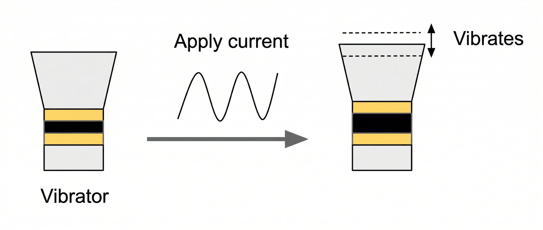
The mechanism for generating ultrasonic waves in cleaning solution involves applying electrical signals to a transducer to vibrate it and generate ultrasonic waves. A transducer is a component containing a piezoelectric element that changes shape when voltage is applied. By applying wave-like voltage to this transducer, the piezoelectric element vibrates in sync with the wave period. By installing this transducer in a cleaning tank containing cleaning solution, ultrasonic waves are generated in the liquid.
Figure 1. How Transducers Work (Image)
3. What is Cavitation (Ultrasonic Cleaning Principle 1)
The occurrence of cavitation phenomena in the cleaning agent allows it to act on even fine gaps and surface dirt, so cavitation plays an important role in the cleaning process.
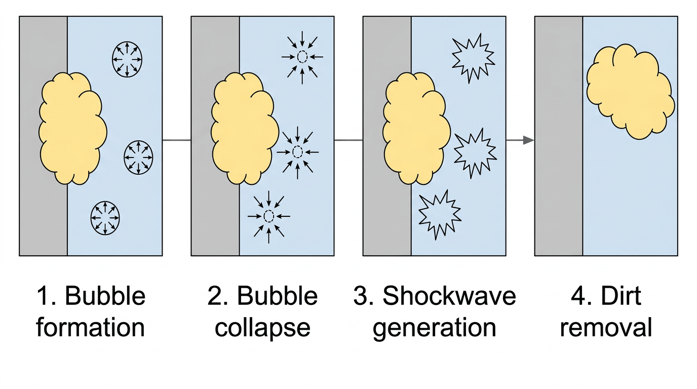
The mechanism by which dirt is removed using ultrasonic waves generated in the cleaning agent is related to a phenomenon called cavitation. The ultrasonic waves generated by the transducer create countless locations in the liquid where water pressure is high and low. In locations where water pressure is low, voids form in the liquid, and in locations where water pressure is high, those voids are crushed and burst. A strong impact is generated when these voids burst. This impact is used to remove dirt. These phenomena are called cavitation.
The strength of the cavitation impact varies depending on the frequency (number of waves). When the frequency is high, the wave amplitude becomes smaller, so the cavitation impact becomes weaker, but because the amplitude is small, fine dirt can be removed and damage to the workpiece can be reduced. On the other hand, when the frequency is low, the wave amplitude is large, so the cavitation impact is strong, and while stubborn dirt can be removed, damage to the workpiece becomes greater. Therefore, when using ultrasonic cleaning, it is necessary to select an appropriate frequency depending on the workpiece and dirt to be cleaned.
Figure 2. Principle of Ultrasonic Wave Generation
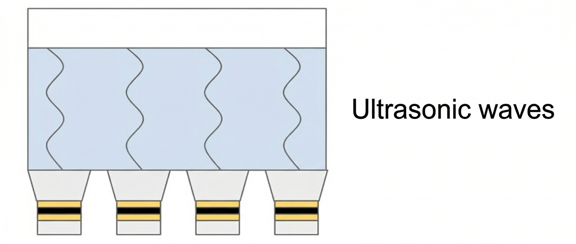
Figure 3. Principle of Cavitation Generation
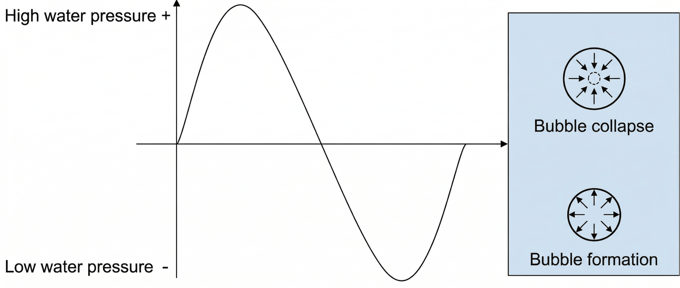
Figure 4. Mechanism of Dirt Removal
4. Selecting Frequency in Cavitation Cleaning
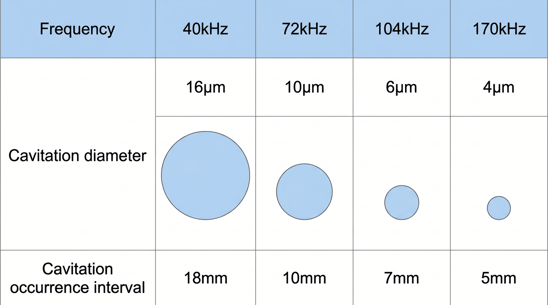
When utilizing the effects of cavitation, it is important to select the optimal frequency for the dirt to be removed and the material of the cleaning object. Table 1 shows the size of cavitation nuclei by frequency
Low-Frequency Ultrasonic Cleaning for "Stubborn Dirt"
First, when selecting frequency from the perspective of dirt, for stubborn dirt such as oil and grease stains, "low-frequency ultrasonic waves" with large cavitation nuclei and large impacts are optimal.
High-Frequency Ultrasonic Cleaning for "Precision Parts" Dirt
On the other hand, when cleaning dirt inside fine precision parts, "high-frequency ultrasonic waves" with small cavitation nuclei and small impacts are optimal.
Importance of Selecting Frequency Appropriate to the Cleaning Object
Also, from the perspective of material, frequency selection that is conscious of damage to the cleaning object is necessary. "Low-frequency ultrasonic waves" have large impacts and may scratch the cleaning object, while "high-frequency ultrasonic waves" have weak impacts and may result in insufficient removal of the target dirt.
Therefore, when selecting frequency, dirt removal power and damage to the cleaning object are in a trade-off relationship, making prior evaluation essential.
Also, the cavitation generation interval differs depending on frequency. At low frequencies, the generation interval is long, so cleaning unevenness is large, while at high frequencies, the generation interval is short, so cleaning unevenness is small. Therefore, there is a method of using multiple frequencies to reduce cleaning unevenness.
Table 1. Characteristics of Cavitation by Frequency
5. What are Direct Flow & Particle Acceleration (Ultrasonic Cleaning Principle 2)
In addition to cavitation, "direct flow effect" and "particle acceleration" are also part of the effects that remove dirt. Let's explain direct flow effect and particle acceleration respectively.
Direct Flow Effect
The direct flow effect is where agitation of liquid flow by ultrasonic waves prevents cleaning solution containing dirt from stagnating, so that fresh solution is always in contact with the workpiece surface.
Particle Acceleration
Particle acceleration is where water molecules in the cleaning solution vibrate due to ultrasonic waves. This vibration effect separates dirt from the workpiece.
6. Ultrasonic Cleaning Can Be Tailored to Various Workpieces
Ultrasonic cleaning is a method for effectively removing fine dirt and dirt inside complex structures that are difficult with brush cleaning, etc. By selecting appropriate cleaning solution and combining the physical cleaning action of ultrasonic waves with the chemical dissolving action of cleaning solution, cleaning effectiveness increases.
Ultrasonic cleaning enables internal cleaning of narrow gaps and grooves in small parts.
7. Contact JFE Shoji Electronics for Cleaning Challenges
Ultrasonic cleaning with high cleaning effectiveness has the advantage that it can be performed in a short time regardless of the shape of the cleaning object. On the other hand, in the case of cleaning objects that are vulnerable to damage, it can be a disadvantage as it may cause scratches, etc. It is necessary to select an appropriate cleaning method for the object to be cleaned.
For cleaning challenges, JFE Shoji Electronics has specialized staff with expertise in customers' on-site cleaning processes who can make proposals tailored to your requirements.
▼Read more related articles here.


-%E3%82%AD%E3%83%BC%E3%83%93%E3%82%B8%E3%83%A5%E3%82%A2%E3%83%AB.png?width=352&name=%E3%80%90%E6%B4%97%E6%B5%84%E3%81%A8%E3%81%AF%3F%E5%9F%BA%E7%A4%8E%E7%B7%A83%E3%80%91%E6%B0%B4%E7%B3%BB%E6%B4%97%E6%B5%84%E5%89%A4%E3%81%AE%E7%A8%AE%E9%A1%9E%E3%81%A8%E4%B8%BB%E3%81%AA%E7%94%A8%E9%80%94(%E8%8B%B1%E8%AA%9E%E7%89%88)-%E3%82%AD%E3%83%BC%E3%83%93%E3%82%B8%E3%83%A5%E3%82%A2%E3%83%AB.png)
-%E3%82%BF%E3%82%A4%E3%83%88%E3%83%AB%E7%94%BB%E5%83%8F.png?width=352&name=%E3%80%90%E6%B4%97%E6%B5%84%E3%81%A8%E3%81%AF%3F%E5%9F%BA%E7%A4%8E%E7%B7%A81%E3%80%91%E7%94%A3%E6%A5%AD%E6%B4%97%E6%B5%84%E3%81%AB%E3%81%8A%E3%81%91%E3%82%8B%E6%B1%9A%E3%82%8C%E3%81%A8%E6%B4%97%E6%B5%84%E3%81%AE%E5%BF%85%E8%A6%81%E6%80%A7(%E8%8B%B1%E8%AA%9E%E7%89%88)-%E3%82%BF%E3%82%A4%E3%83%88%E3%83%AB%E7%94%BB%E5%83%8F.png)

_%E3%82%AD%E3%83%BC%E3%83%93%E3%82%B8%E3%83%A5%E3%82%A2%E3%83%AB.png)